An Interview with Nathan Lang

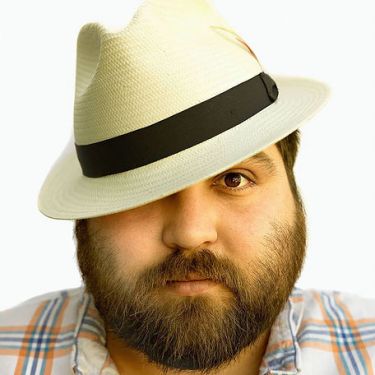
Stuntman press 1 (web).jpgHi Nathan, so where ya from & where ya at, geographically speaking?
I was born and raised in Melbourne, Australia. I moved to London ten years ago and live in Hackney with my wife and two dogs. She’s Scottish and they’re Chinese. We go to Scotland a lot but not China.

Performance is clearly in your blood – when did you gain the first inkling of this?
My first memory of performing was in the early 80s when I would amuse myself and no-one else by recording comedy sketches onto cassette tapes. I would parody TV commercials and personalities, do silly characters. Sometimes I’d layer extra voices and sound effects by using an extra cassette deck, the kind of high-tech innovation that got us to the moon.

After a successful career on Australian TV, why branch into Comedy?
Your intriguing use of the word “successful” suggests I actually had a successful career on Australian TV. I had some excellent guest roles and got to play Pinhead on Neighbours for two years, but I don’t think my TV career ever really took off there. I was never made any offers, I still had to audition for hundreds of jobs I never got. But I was always doing comedy. I wrote, performed and directed university revue shows, and started out at Melbourne International Comedy Festival doing sketch comedy, all while maintaining my dynamic daily routine of waiting for my agent to call.

Who are your comedy idols?
The only act I’ve ever been properly fanatical about is the Doug Anthony Allstars. I grew up watching them on TV, went to their live shows, wore the T-shirt, bought all the merch, got interviewed by press at their Farewell Tour in 1996 and consequently reprimanded by my headmaster for bringing shame to the school for associating with such a subversive act. I always loved Flacco too, a really bizarre clown – his creator Paul Livingston is a linguistic gymnast. I can’t wait to see them all together in Edinburgh this year. I hope to bore at least one of them with my tale of how they inspired me to be an unemployed career comedian.


What does Nathan Lang like to do when he’s not being funny?
Oh that’s a lot of the time, even on stage. I have two companies – Jon & Nath (sketch) and Farce Forward (clown theatre) – and I run experimental comedy night Lost Cabaret, so there’s a lot of admin, which is not humorous. Before answering this question I got up and swept the floor, so I’m doing really well.

You’re still making TV & Films, where should we expect to be seeing you?
I just filmed a small part in The Favourite, a feature film directed by Yorgos Lanthimos. I remember watching The Lobster and thinking how much I’d love to work with such a peculiar, visionary director… Suddenly I’d auditioned for him and was on his set. The Favourite stars Olivia Colman, Rachel Weisz and Emma Stone, they are all brilliant, the film is going to be amazing, and you can see me in it next year if you watch very closely.

stuntman-A3_edinburghUNDER2MB

You are bringing The Stuntman to this year’s fringe… can you tell us about it?
The Stuntman is my first solo show, it’s so much fun and I just love doing it. Essentially it’s a clown piece – absurd, surreal, silly and interactive. There’s mime, but it’s not a silent show. It’s the story of a completely idiotic daredevil, told through physical comedy, games, actual stunts, and a few touching moments too. I decided to make it largely non-verbal so it’s accessible to everyone regardless of language.

What makes you laugh personally?
My dogs crack me up. They are good clowns. We adopted two rescues – Albert Fudge and Cherub Chow. They’ve learned to be cute and silly to get attention and treats, and they do some ridiculous things. If you’ve never seen two Shih Tzus playfight, put it on your list. My wife and I call it Dog TV because we don’t have a TV. (As far as TV Licensing is concerned, we never watch anything online either.)

Will you be performing the Stuntman after the Fringe?
Yes I hope so because my Edinburgh Fringe run is only short (eleven performances – I’m splitting the Fringe season with my sketch comedy show Jon & Nath Like To Party). It’s a high-energy show, very physically demanding, so I want to keep doing it before I become a middle-aged slob. I am open to booking offers from anyone but cruise ships.


Nathan Lang will be risking his life in the name of comedy at the Fringe

Aug 16-27 : Laughing Horse @ The Free Sisters

An Interview with Jon & Nath

J&N press image 2 (web).jpeg

Hi lads, so where ya both from & where ya at, geographically speaking?
Jon : I was born in London and Nath was born in Melbourne. I moved to Melbourne and lived there for a while where I met Nath. Then we both moved to London and have been living here a while. There’s a nice symmetry to our geography.

Can you describe your chemistry with Jon?
Nath : Jon and I are brothers. We’re twins in the womb and he’s the one who gobbles up all the food, leaving me malnourished and gaunt. We disagree about pretty much everything except our own comedy work. We actually fell out for three years and it’s really helped us come together with even more antagonism than ever before. I asked Jon to marry me once, bought him flowers, got down on one knee and everything. If he’d said yes, this year I’d be giving him a silver sugar bowl for our 16th anniversary. True story.

When did you realise you were, well, funny?
Jon : I think everyone has the ability to make other people laugh but getting paid for comedy the first time was a landmark night. There is no better sound than the sound of laughter you’ve created. Equally, there is nothing more crushing than hearing some guy yell out “You’re not funny, you ugly wanker!” from the depths of a darkened room. So in conclusion probably around mid-2000.

J&N press image 3 (web).jpg
What are the inspirations behind your own comedic output?
Nath :
I grew up in Australia watching excellent British TV comedy like Kenny Everett, The Young Ones, Blackadder and Fry & Laurie. And Aussie stuff like Fast Forward, The Comedy Company, The Big Gig and The Doug Anthony Allstars. So I like a bit of anarchic danger underpinned by well-written, well-rehearsed material, and recurring characters. I grew up on sketch comedy and have always loved doing it. Lately I’ve been training in and watching a lot of clown (I’m also doing a solo clown show this Edinburgh Fringe called ‘The Stuntman’). I’m inspired by everyone I see doing comedy, there are limitless perspectives on what is funny and how to generate laughter.

How did you guys meet?
Jon : We saw each other’s shows in the Melbourne International Comedy Festival, then went out drinking on the beach. Nath and I were smoking, and he said “Don’t drop the butt in the sand, I’ll put them in my pocket.” I was just about to say the same thing to him, so a life-long friendship was born! We were socially aware before it was cool. Oddly we have almost nothing else in common whatsoever.

J&N press image 6 (web).jpeg

What’s the difference between an Australian audience & a British?
Nath : Audiences in Australia like to have comedy thrown at them, whereas in the UK people examine everything you do, and appreciate nuances. It’s a difference of subtlety.

You’re bringing ‘Jon & Nath Like to Party’ to the Fringe. Can you tell us about it.
Jon : ‘Jon & Nath Like To Party’ is a pretty sweet sketch show we have been working on since Camden Fringe last year. It has everything from incredible robotics* to stella guest appearances**. We’ve worked really hard to get the show to a relentless pace, mixing the absurd and satirical without overdoing either.
*Jon in a shitty tin-foil suit
** Nath’s below-average impressions

What are the ingredients to a good sketch?
Jon : I think stupidity, bad accents, wigs and fake moustaches while Nath insists it is good craft, clever writing and lots of rehearsals. We meet in the middle and that’s what makes ‘Jon & Nath Like To Party’ so good.

J&N-A3-EdinburghUNDER2MB

You performed ‘Jon & Nath Like to Party’ at the Brighton Fringe. Have you been making any tweaks since then?
Nath : Yes I’ve tried to write Jon out of the show but he keeps turning up at gigs. We’ve been working on ‘Jon & Nath Like To Party’ for a year, so Brighton Fringe was a version we are very happy with. Our aim is to create a sketch show that also communicates our relationship through an underlying narrative of thwarting and one-upmanship. By the end we’ve messed each other up pretty good. At our latest preview we started bitching about each other directly to the audience, but it’s really quite sentimental too.

What will Jon & Nath be doing after Edinburgh?
Nath : I heard an anecdote about what Miles Davis and John Coltrane would do after jazz gigs – Davis would go out partying, and Coltrane would go home and practise the bits he wasn’t happy with. Jon and I will probably just do the Davis. Then we’ll keep booking gigs, writing, filming, working on a new show, and hopefully touring ‘Jon & Nath Like To Party’. The lols aren’t going to make themselves (until we’re rich enough to pay people to make the lols for us and package them for internet orders).


Jon & Nath will be performing at the Edinburgh Fringe

 Laughing Horse @ The Free Sisters (Venue 272)
Aug 3-14 (13.30)

An Interview with Danny Lobell

Danny head shot

Hello Danny Lobell, so where ya from & where ya at, geographically speaking?
I’m from the cosmos and I’m feeling more at one with them than ever. That could also be interpreted as “New York” and “LA.”

When did you first realise you were, well, funny?
I made the doctor laugh as I was being delivered. Before he could even cut the umbilical cord I told him a really funny story about being in the womb. Had him rolling. He laughed so hard he almost forgot to cut me loose. Then I did 20 minutes of stand up in an incubator. It’s some of my best stuff. I wish I’d written it down.

Why stand-up comedy?
It’s a great format for painting pictures in people’s heads. I like making people laugh and bringing them joy. I also like comedians. They are some of my favourite kinds of people. They are usually misfits, messed up in some way, or even complete degenerates but they all have big hearts, lots of creativity, and don’t let a conversation get too boring for too long.

Upon which life-experiences do you draw your own comedy?
The ones that I find funny. You have so many experiences every single day and every single moment of your day is occupied with something. But at the end of the week how much do you actually remember? And of what you remember, how much of it makes you laugh? I try to isolate the funny parts of the week and when they compile, I tend to select the funniest ones of them. I then merge them together into a show.

What does Danny Lobell like to do when he’s not being funny?
I like to paint, write comic books, play with my dogs, watch TV with my wife, do repairs around the house, and cook.

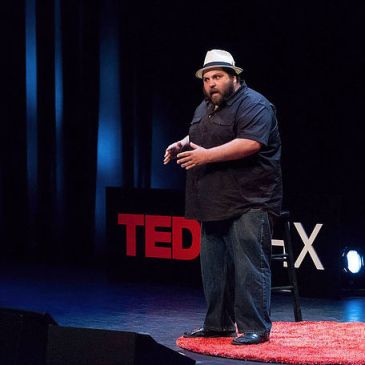
Danny Lobell TedX

You did rather well at the Glasgow International Comedy Festival, can you tell us about the experience?
Rather well? I was phenomenal! And that’s me being humble! I’ve been privileged enough to have done the Glasgow International Comedy Festival three times. I got some great write-ups in The Scotsman and The Daily Record. I got to be on BBC Scotland radio. I made some wonderful friends with whom I’m still very much in touch like the hilarious Raymond Mearns. In my opinion, he’s the funniest man living in Scotland right now. All the people who run the festival are terrific. Sarah Watson has a great eye for talent and makes everyone feel very at home when they do the festival. I even recorded an album at the festival the last time I was there in 2011 at The Stand in Glasgow. It’s probably my favourite comedy club in the world.

What is it about performing live you love the most?
It’s the only way I ever perform. I like doing everything live. I like eating live, sleeping live. In fact, being alive has really enhanced most of my life experiences.

Broke As A Joke Flyer.jpg

You are bringing your show, Broke as a Joke, to the Fringe this August, can you tell us about it?
It’s a collection of stories, anecdotes, and jokes that revolve around my adventures that came out of being broke. It includes everything from odd jobs like selling light bulbs door to door and working for comedy legend Jackie Mason selling audio cassette tapes at his Broadway show. I also talk about failed business ideas like breeding hairless cats and selling eggs to hipsters. It’s got action and adventure in it, like when I pulled off a drop and run of a rooster with a former drug lord and returned a year-old piece of salmon with my dad to the store. The show is funny, exciting, heartfelt, and comes with a little advice I’ve learned along the way.

As a cross-cultural child, will we be seeing touches of each humour in your set?
Yes. I was raised with humour on both sides. I think New Yorkers and Glaswegians, both being very blue collar, depend heavily on comedy to get through life. I developed sharp comedic sensibilities having been raised by parents from these two great cities.

This will be your debut at the Fringe… what have you heard about it from other performers?
I’ve heard that it’s one of the most fun and challenging months of performing and I welcome both the fun and the challenge.

Danny Lobell HS

What does the rest of 2017 hold in store for Danny Lobell?
Wonderful wonderful things. Some of them are highly top secret, so secret in fact that I don’t even know about them. But I’m telling you they’re great. I heard a rumor that I’m going to win a llama farm in Peru while appearing on a local game show there. One of the llamas, unbeknownst to them before they signed it over to me, has very rare markings on its back. These markings make it very collectible on the llama message boards on the dark web. I will be offered an incredible sum of bit coin for this llama. We will have to meet up in person with the llama for its assessment before the transfer goes through.
When I get there, I will recognise two Serbian men. One of them bald, with eyebrows under his eyes instead of on top. And the other one looks pretty normal but has way too much sodium in his diet. He doesn’t even realise it but he’s at risk for all sorts of severe health problems. As they start looking over the llama, I remember where I’ve seen that normal looking Serbian guy. He was on PETA’s most wanted list for verbally abusing a red panda in 1999! I will know right there and then that I am NOT selling this llama off to these two guys.
I try to excuse us politely from the situation but they can tell something is up. As it becomes increasingly uncomfortable, we try to make a dash back to my two-door Mazda Miata convertible that I rented at the airport. But the two Serbians chase after us. It’s at that point that the llama and I put our backs together and start fighting these two guys as a llama-human-ninja team. We beat the crap out of them, jump into the Miata and drive away.
Just when I think there is no way I’m ever gonna be able to cash in on this llama farm thing, I find out that TMZ got ahold of the security footage and that the llama and I have gone viral. All kinds of offers start pouring in from Hollywood for an action buddy cop movie. We become a franchise and retire after making only five movies that gross more money collectively than all the super hero movies of the past decade combined. We buy a small island and live out the rest of our lives sipping mojitos and oatmeal puree (that’s what llamas like to drink) while watching the sun go down over the ocean.

If that doesn’t happen, then probably some more gigs.


You can catch Danny in Edinburgh this Fringe
theSpace @ Jurys Inn Space Studio
Aug 4- 25  (16:05)

An Interview with Siân and Zoë

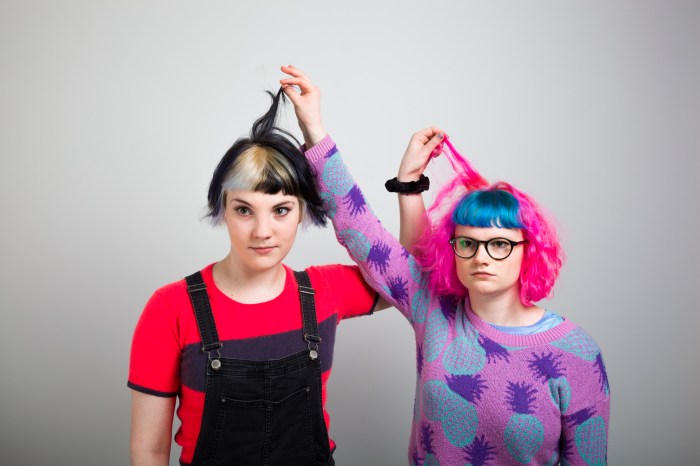
NR 16-12-10 215.jpg

Where y’all from and where y’all at?
Siân: I’m originally from the suburbs of Brussels, Belgium, so yes I am very exotic.
Zoë: I grew up on the Isle of Arran in Scotland. We’ll leave it up to you who won in the ‘mildly unusual hometown’ category. We’re both now based in London.

Can you describe in one sentence the experience of performing at the Fringe?
Siân:Zoë I’m so sorry about eating the props.”

When did you first realise you were, well, funny?
Zoë: I was about 16. I wrote a comedy play about a murder on the set of a kid’s TV show. I’d written sound effects into the script like I had the full BBC Radiophonic Workshop in the tech box, but actually it was just my mum. She obviously messed up one of the cues, so I broke character and said: “I knew I shouldn’t have asked my mum to do the tech”. The music still wasn’t playing so I kept improvising, which was much funnier than what I had written. That’s when I first thought: “People laughed when I said something that wasn’t pre-prepared”. My mum still comes to our shows and heckles us so we can make jokes about it. Actually maybe it’s my mum that’s funny. Maybe the act should be Siân and Zoë’s Mum?

Why comedy, what is it about being funny in front of other people that makes you tick?
Siân: The first time I did stand-up was after auditioning for a Footlights gig I didn’t get into. There were two guys outside the audition room who told me they were organizing a fundraiser comedy gig, and did I do stand-up? I lied and said “Yeah, sure”. The ten minutes of “comedy” I did was resolutely average, and probably better just described as “words.” But I got the bug for it. I’d also done odd bits of sketch comedy about things like IKEA furniture having a nervous breakdown, sex guru post-it notes and various other haunted-office-equipment-related material. Which has kind of just kept going. The reason it makes me tick may well be that I ill-advisedly swallowed a desk clock during a sketch at some point and the battery poisoning made me forget all about it.


Upon which life-experiences do you draw your own comedy?
Zoë: I also absolutely love horror films, which I hope comes across in our show this year. I once made Siân watch ‘The Exorcist’, and she still thinks the girl is climbing down the stairs backwards to get her. To be honest, Siân’s better at using actual life experience than me; her solo stuff manages to explore personal identity in a way that isn’t annoying. And that’s high praise from me as I am easily annoyed, especially by Siân.

SZ-SCFN-A3-WEB

So Siân, you are currently doing some serious acting in “Queers” at the King’s Head Theatre. Is this experience influencing your comedy act with Zoë in any way?
Siân: It has, in the sense that I think all performance experience is valuable and teaches you something. The “seeryuss ahhcting” has pushed me out of my comfort zone, and I’ve had to convey all these emotions without the safety of making a joke about it. It’s pretty exposing and I’m not sure if I like it. But I love the show. And I do think – in a way that possibly borders on the obnoxious – that it’s important to be visible and honest as an LGBTQ person, within the limits of what’s possible for your own safety. This is the second time I’ve performed in “Queers”, and for a while I was the frontwoman of a feminist cock-rock drag band called “The Dykeness”. So yes, it has influenced our act, in that it has made me an expert on “keeping it subtle”.

How did S&Z come about?
Zoë: Siân auditioned for a stand-up comedy night I hosted at university. I thought “Wow, she does what I do but better. I should 100% drag her down to my level”. We’d never written any sketch comedy together so obviously we wrote an hour in a week and ran it for five nights in a row. We’ve been working together ever since.

So Zoë, can you tell us about your dayjob as a researcher?
I work in TV as a researcher for comedy panel shows, finding props, pictures, clips and anything else that can lead on to gags. I’m delighted someone wants to pay me to be a comedy nerd, because before this I’d been doing it unpaid since I was 11. We also develop games and sketches, which means when I’m working I have to keep contacting Siân to ask: “Have I accidentally stolen this idea from our writing session last night? And if so, please can I carry on stealing it?”.

What are the ingredients to a good sketch?
Siân: Every sketch is different and every sketch act is different. But I think a key thing across the board is to have one core idea for each sketch, and see it through. Having said that, the original ingredient in a sketch is your own voice. Sketch groups we really like can both write sketches that anyone could perform, but also have a style that is distinctly theirs. And that comes down to the personalities, interests and idiosyncrasies of the writers/performers. I felt like there were two or three sketches in our show last year that were really “ours”, which was cool. It can take ages to figure that out. But it’s the most fun.

SZ-SCFN-A3-WEB

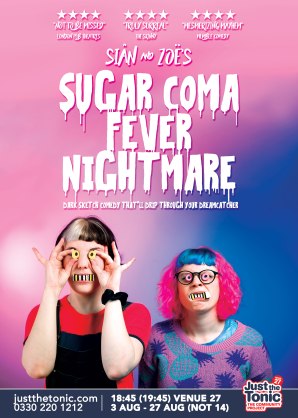
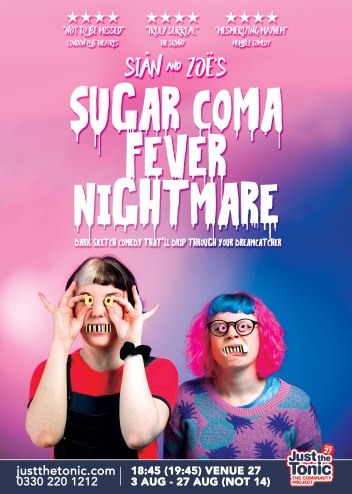
You are bringing Sugar Coma Fever Nightmare to this year’s Fringe, can you tell us about it?
Zoë: Sugar Coma Fever Nightmare is a dark sketch show about bad dreams, and two people made of liquorice who want to eat flesh allsorts.
Siân: It’s still very much an alternative comedy show, so there’s lots of visual business and the offbeat stuff that we like. But the dream setting has given us loads to play with in terms of characters and sketches that exist just outside of reality. Please note that although the show is dream-themed, we have put a lot of work into it so having a nap through the show will not produce the same effect. (HI DAD.)

This is not your first time at the Fringe, what have you learnt in the interim about your set?
Siân: The Fringe has something for absolutely everyone. One year I was in a folk-punk opera version of “The Bacchae,” mostly about binge-drinking, aimed at ten year olds. It did alright. Also, there are pretty decent £1 sandwiches in Boots. Artistically, this is very important.

Was constructing this year’s show easier or more difficult than your first?
Zoë: Much easier! Obviously we’re more experienced but the theme of dreams and nightmares works perfectly for sketch so I think we’ve had more fun with that – moving between sketches is much more natural if it’s happening in a dreamscape. It’s been exciting to pull characters from different parts of the show into each other’s sketches, as we move through the hour, to build the effect of a nightmare. I’ve also enjoyed pushing our bubblegum characters into horrible situations.
Siân: Previous years have been nightmarish so we’re delighted we can finally put that extensive bank of experience to use.

Photography : Nick Rutter / Jon Bailey


sianandzoe-6.jpg

You can catch Siân and Zoë at the Fringe

Aug 3-13, 15-27

Just the Tonic @ The Community Project (Venue 27)

18.45

An Interview with Sandra Hale

Edinburgh Fringe_A6_front.jpg

Hello Sandra, so where ya from & where ya at, geographically speaking?

I live near Potters Bar in Hertfordshire until the marital home is sold and then who knows ? I shall be a free agent and can live where I please if I get a reasonable financial settlement!

You have been in the business of showbusiness for sometime now – can you give us a whirlwind summary?
Whirlwind summary of my showbiz career.. played Sidney James’s daughter for a year. Worked with some comedy greats.. Charles Hawtrey in No Sex Please we’re British. John Inman, Harry Worth, Clive Dunn… all dead now. That’s why I’ve got to get a move on! TV I’m still getting royalties for The Bill, Londons Burning, The Sweeney etc.. I often played a tart or a grass. More recently I’ve appeared in BBC 3’s Top Ten comedy shorts with Chris Stokes called Life Lessons.Things that are said to Vegans.Several commercials. One for Persil where I played a Russian Psychic and today my Virgin Games commercial has just come out where I play a laundrette worker!

Why stand-up comedy?
I’ve always loved making people laugh and when the acting work started to dry up round about the same time I did, I decided to have a go at comedy to scratch the performing itch

What are the secrets of a good joke?
The secrets of a good joke? Can’t tell you, it’s a secret!

IMG_1223.JPG

What does Sandra Hale like to do when she’s not being funny?
When I’m not trying to make people laugh, I can be found eating. I love to eat. Love it. My mouth is always on the go. That, and reading. And fortunately the two go together so I’m lucky.

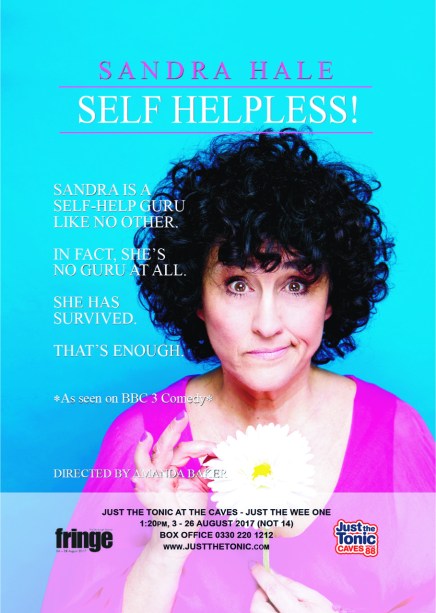
You are bringing your show ‘Self Helpless’ to the Fringe this August, can you tell us about it?
Self Helpless! is a show filled with insights that will help you get through life providing you have good looks, no opinions, and can tap dance.
Sandra Hale is a self help guru like no other. In fact she’s no guru at all. She’s survived. That’s enough.

You have also written a book to accompany the show – has that enhanced the depth & quality of the act?
My book is a complete antithesis to every self help book out there. After all we can’t all be selfless, moralistic and confident. So if like me you are insecure, needy, and a people pleaser then this book is for you. You may still have low self esteem after reading it but you won’t care. The show came first and the book evolved from it. They are both different but the theme runs true in both. Never be yourself! It doesn’t work!

What emotive responses would you like from your audience, & what do you expect?
I want my audience to love me. I need their approval and I do practically anything to get it. I have zero self respect

What does the rest of 2017 hold in store for Sandra Hale?
2017 hopefully will bring me adulation, popularity and gifts..
I can hope can’t I ?


Sandra will be performing in Edinburgh this Fringe

Aug 3-26 : Just The Tonic @ The Caves (13.20)

An Interview with Ellyn Daniels

_MG_9353.jpgHello Ellyn Daniels, so where ya from & where ya at, geographically speaking?

I am from Orlando, Florida but I now divide my time between Los Angeles, London and Barcelona.

When did you first realise you were, well, funny?
I remember making my first joke in kindergarten. My teacher said something to the effect of “we are going to start with step one, then move to step two, etc” and I raised my hand and said, “I don’t see any stairs in here.” And the class laughed. Terrible joke. But that was my first memorable experience making a group of people laugh.

Who are your comedy idols?
Lucille Ball, Eddie Murphy, Robin Williams, John Cleese, Eddie Izzard, Sarah Silverman, Sacha Baron Cohen, Russell Brand

You work as a model. How the hell did you end up getting into stand-up?
I was modeling in LA. I started getting some acting gigs in commercials and TV shows so I stayed for a while and ended up meeting several people in the business, including one well-known stand-up comedian, who told me I was funny and should do stand up, so I gave it a shot.

What is the difference between an American comedy audience & a British audience?
In my experience, an American comedy audience has less patience for set ups and nuances. They want you to get to the punchlines quickly. American audiences are also more accustomed to the traditional rhythm of stand-up comedy so they get bored much faster if you are doing hacky jokes. They want to be surprised and they won’t give you many polite laughs just for being clever. They want to be moved to big, visceral laughter. A British audience, on the other hand, listens more carefully to the set ups, they laugh much more at nuances and they give you a lot of credit for being clever. They are better listeners and they are thinking while they are listening, so they catch more information. Less is lost on them.

What does Ellyn Daniels like to do when she’s not being funny?
I like to see my friends and have long dinners or spend hours walking around and chatting. I like to write. I try to write screenplays in my free time. I like to study languages. I like to travel. And I still love taking ballet class.

Emotional Terrorism image HI RES.jpg

You are bringing ‘Emotional Terrorism’ to the Fringe. Can you tell us about it?
Emotional Terrorism is a one woman show which I wrote as an attempt to understand my demons and the voices in my head through a humorous lens. I explore some elements of my childhood including my parents’ irrational fear of HIV, being sexualized at a young age by ballet teachers and the modeling world, developing an eating disorder while working as a teenage model, contracting an STD from my first boyfriend, my absurd experiences studying acting in LA with an abusive, ego maniacal teacher and my descent into alcoholism and the demoralization that came along with it. It’s a dark comedy.

What emotive responses do you expect from your audience?
I have been performing the show as part of The Hollywood Fringe Festival and audiences have laughed, gasped and cried throughout the show. I think people’s reactions to the show depend on their personal experiences, but most people have some sort of strong emotional experience while watching it.

How do you think you will find performing at the mega-mash-up that is the Edinburgh Fringe?
I think it will be an amazing experience and I am very excited about it.

What does the rest of 2017 hold in store for Ellyn Daniels?
I have no idea. I’m not one for planning very far ahead.


Catch Ellyn Daniels ‘Emotional Terrorism’ at Just The Tonic at the Caves

3rd – 26th August at (21.00) 

An Interview with Jen Wakefield

profile box image.jpegHi Jen, so where ya from & where ya at, geographically speaking?
I’m from a place called Sunbury-On-Thames which borders South West London and Surrey (I like to say under the Heathrow flightpath!) but I now live in Camden.

When did you first realise you were, well, funny?
I played the role of Eliza Doolittle in my college production of My Fair Lady, and I got some good feedback about the way I’d used humour to perform one of the songs. Then when I was a teacher I used to do impressions of the funny, sweet and silly things that children, parents and others would say and I think I just enjoyed making people laugh.

Who are your comedy idols?
Chris Lilley, creator of ‘Summer Heights High’, ‘Angry Boys’ and ‘We Can be Heroes’ is a comedy genius. I admire how he uses the characters narratives to highlight the blind spots of society, and his character creations are some of my favourites to exist – especially Mr G! Harry Enfield is high on the list for his hilarious and timely sketches. Luisa Omielan for what she has contributed to comedy with her recent shows that are hugely funny, relatable and empowering, and finally Pajama Men who blow my socks off with their characters and sketches. I could watch them do the same thing over and over again and I would always nearly wet myself.

Upon which life-experiences do you draw your own comedy?
For my most recent show, personal experiences that have happened as a timeline from age six onwards. It would often come from what others would ask or say to me, and me not being able to give a simple answer about where I’m from. I became more aware of the idea of ‘labeling’ since trying to forge ahead in a performance career because of the needs of a casting criteria. The feeling of being an ‘inbetweener’ was a strange one and so I drew out all the reasons why it was strange and tried to piece it together in a comedic puzzle.

What does Jen Wakefield like to do when she’s not being funny?
Jen Wakefield likes to watch things that are funny. Annoyingly now that my hobbies have become my career choice, I need to find new hobbies! I watch lots of stand -up, Improv and Soho Theatre shows. I also write occasionally about dance and theatre productions. I enjoy keeping up with music and have been presenting my own radio show on Watford’s Vibe107.6fm. Radio is something I’m also pursuing along with polishing my comedy training wheels with The Free Association who I am training in improvisation with. I’m currently learning how to execute a ‘Harold’ which is like learning a whole new sport in itself!

Last year you performed in various places through the Fringe, did you feel overloaded or take it in your stride.
I think I took it in my stride. Compared to other people’s Fringe commitments it wasn’t too bad. Along with our own show, doing an extras role in a Pleasance Show (My sketch partner and I had small roles in the BEASTS Mr Edinburgh show at The Pleasance Dome each night) was great for meeting other comics and was socially very rewarding. So I mostly saw it as a lucky bonus.

jenposterA2_lightyellow

You are bringing us your debut one-woman character show ‘Girl In Da Corner,’ to the Fringe. Can you tell us about it?
Yes I can! It is a character comedy show about identity and explores the mixed-race experience that I’ve had. I wrote an article titled Sorry, you’re label has expired about growing up identifying as Anglo-Indian and found it was met with a greater response than expected. Lots of people contacted me to share their similar experiences, so I thought it might be a topical piece to explore in a show, and I hope there might be other people who can identify with the content or it may spark a conversation. There are lots of different areas covered, but the identity crisis is laid bare through my main character called ‘Natasha G-Storm Flex’ who is delivering her ‘Grime Outreach programme-taking Grime to hard to reach areas’. So there will be three original Grime/Rap songs which I’ve written, and there are various other sketches and characters which will make for a high energy and fun 50 minutes.

Can you sum up your show in a single sentence?
A show that unearths the mixed-race experience through characters, comedy and music!

As a cross-cultural child, will we be seeing touches of both Indian & British humor in your set?
Yes definitely. Two characters which are becoming a bigger feature of the show come from Delhi and Mumbai, and explore the feelings they have towards each other and their own charms and prejudices. There’s also a song called ‘Biscuits and Bars’ about Natasha G-Storm Flex’s time spent with the Cheltenham Women’s Institute. It doesn’t get more British than that!

You are also a blogger of some aptitude, does this way of writing penetrate your material?
I think if you try to exercise your writing muscle it can be beneficial for helping to take the anxiety out of ‘getting started’. Comedy and blog writing are very different in style but I suppose it has helped me to develop my own voice and opinions which appear in the show.

What does the rest of 2017 hold in store for Jen Wakefield?
At the moment there is razor sharp focus on the Fringe. Most of my energy is going into the show, currently and thinking about the shows life after Edinburgh, but I do have gigs planned for after Edinburgh. I’m also still pursuing radio on a different level so I shall keep plugging away at that, along with the training and involvement with The Free Association. More writing, more performing, more flexing!


Jen Wakefield will be winging in to the Edinburgh this Fringe

Aug 3-27 : Laughing Horse @ The Cellar Monkey (13.15)

An Interview with Laughing Stock

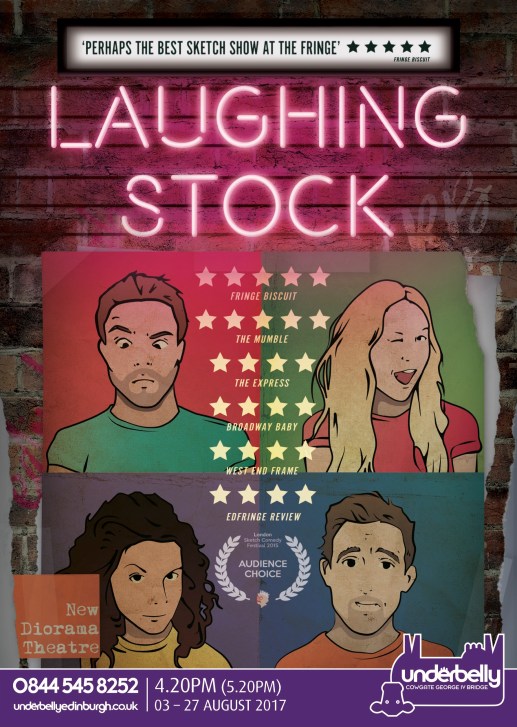
Poster 2017

Hello Laughing Stock, so where are ya all from & where ya’ll at, geographically speaking?
LAUGHING STOCK : Lewis is from Nottingham, Bella is from Oxford, Phoebe is from Somerset and Rhys is an army child so he’s from nowhere. Currently, we all live in London.

Rhys.JPG
Rhys Bevan

So where did the idea for Laughing Stock originate?
RHYS : The sketch show was really a reaction against leaving drama school and having lots to say and nowhere to say it anymore. I grew up watching sketch comedy, and I’d done it at University, so I knew that was something that I wanted to do. So did Phoebe. So we met up a few times, roped in a few mates to workshop some stuff and lo, a strange foursome was born.

This is not Laughing Stock’s first time at the Fringe, what have you learnt in the interim about your set?
ARABELLA : A big thing we’ve learnt is not to be afraid of showing off. If you think you can pay an instrument, or sing, or dance, or move then whack it in a sketch. There’s nothing more satisfying than watching something that is both very funny, and kind of impressive. There’s something selfless about really committing, and the audiences really take to it. So I, in particular, like to get as much live music in the show as possible.

Phoebe Higson.jpg
Phoebe Higson

What is the creative process behind writing Laughing Stock’s sketches?
PHOEBE : I write it all. Joke. We all bring as much material to meetings as we are able. We present that stuff, decide what we all like, then we trial it in front of (usually non-fee-paying) audiences and see what they like. It’s really important to create stuff in conversation with an audience. They are your guide. And then only the best stuff makes it into the show. So it can be a gruelling process. And you only see the tip of the iceberg.

Lewis_Doherty .jpeg
Lewis Doherty

What are the ingredients to a good sketch?
LEWIS : There has to be a game, some jeopardy between the characters that makes the scene interesting and alive. The ‘story’ of the sketch. But that can be absolutely anything. And is always subservient to the funnies. E.g. if there’s just a really funny noise you can make in the middle of this really tense scene, do it – and get offstage.  Oh and, of course, my personal favourite, WACKY CHARACTERS!! (That may or may not be a joke from the show).

IMG_3613-edit 2 Low Res

What kind of audience response does Laughing Stock convoke – both during & after the show?
PHOEBE : Last year was brilliant. We sold so well, even better than we’d anticipated. And we had a very lively, upbeat show with a bit of pathos at the end. People generally came out beaming and full of emotion. We try to make the audience comfortable from the start too, so if we do get them involved (which is often) then they feel safe and ready to play.

What are the inspirations behind your own comedic input into Laughing Stock?
RHYS : On a day to day basis, it could be anything. A person I’ve met, a situation I’ve found myself in, or just a turn of phrase. More generally I think we all derive our inspiration from the sketch comedy we grew up with – our style tends to fall somewhere between Smack the Pony and The League of Gentlemen.

Arabella Gibbins.jpg
Arabella Gibbins

Why comedy, what is it about being funny in front of other people that makes you tick?
ARABELLA : I think it makes everyone tick. Which can be dangerous, you don’t want to depend on it. But I’ve always written funny songs to go in amongst the more serious ones I write. When you have lured people in with comedy, something that binds the people in the room, then they are more present for the more serious stuff.

How much time do you guys spend together outside Laughing Stock?
LEWIS: Sadly, that time has got less. I’m a massive advocate for pints and pub trips, because in those conversations when you’re not worried about all the admin stuff and boring things that come with performing, that’s when the best ideas come. But you get older, and you become busier, and we tend to be quite tight for time now when it comes to our shows. But we’ll continue to make time for those trips. Who knows, maybe this year we’ll have the show in the bag by July…

Can you describe in one sentence the experience of performing at the Fringe?
LAUGHING STOCK : It’s like selling rice at the world’s largest rice market, in China – and it’s awesome.

——————————————————————————————————-

Laughing Stock will be performing at the Edinburgh Fringe this August

@ The Underbelly

3-27 (16.20)

An Interview with Nick Revell

Nick-Revell-008.jpgHi Nick, so where ya from & where ya at, geographically speaking?

I’m a Londoner; born there, live there, but was brought up in Yorkshire. So, a cockney with strong Northern roots. Go figure.

When did you first realise you were something of a comedic storyteller?
When you move from London to Yorkshire at the age of seven, being able to get a laugh is very useful. Equally, setting out to be funny in that situation and then failing can be…less useful. So you have to get the techniques down fast.

You’ve been writing comedy now the the best part of four decades. Has the public’s sense of humour changed in that time
As far as live comedy is concerned, I think you still find pretty consistently distinct and different senses of humour in different parts of the country. As far as what’s on TV, radio and other media platforms, I think it’s clear styles and genres go in and out of fashion. PeopIe have way more access to more varied content so they’re probably more open to different and experimental forms than they were. On the other hand, once you scratch beneath the surface, how different is any of it in essence…so the answer is…”yes, no, possibly, of course”….I could go on like this for ages and it wouldn’t become any more lucid.  All you can say for certain is that you never know if something’s funny until you’ve run it in front of an audience. Which is great, because that perpetual self-doubt generates a constant low-level panic and stress which in turn cause a constant propensity for alcohol, tobacco and substance-abuse or neurotic behavioural alternatives which can surely only be good for your health.

Who are your comedy idols?
Ooh….so difficult: Laurel and Hardy. Lenny Bruce. The current White House. Billy Connolly. Victoria Wood. Francois Rabelais. Alexei Sayle. The Pythons. Evelyn Waugh. Richard Pryor. Dario Fo…No doubt I will think of more the minute I send this to you.

You brought ‘Gluten Free Jesus’ to last years Fringe – how did it go down?
I was very happy. A lot of people came to see it, and I got great feedback (including a very nice review from Mumble!). A lot of comedians said very kind things about it. Having an enthusiastic reaction from your colleagues and comrades is of course, particularly pleasing. I also felt I was breaking new ground. Getting outside a comfort zone is always laudable. But only if it works.

NR-A3-Ed-poster (4)

This year you are bringing us ‘Nick Revell vs Lily, Evil Cat Queen of Earth Planet and the Laughing Fridge.’ Can you tell us about it?
It’s in a similar style to last year’s show – a surreal and structured story which runs for the full hour. And audiences seem to be enjoying it. There’s plenty of jokes, but I don’t do any audience interaction, and very little improvisation. It’s about Artificial Intelligence and robots taking over and specifically about how I saved us from my cat becoming a ruthless global dictator. Entirely true, of course, but the events I describe were so traumatic that most of us seem to have wiped them from our memory. (The plague of zombie rodents for example. You mention that to people now, it’s like it never happened.) There’s a satirical element, but it’s less head-on than in previous shows. And all the stronger for that. (I think.) I’m also very modest about my personal role as planetary saviour.

Upon which life-experiences do you draw that certain quirkiness of your comedy – or is it all from your imagination?
Well, in this case, as I say, it’s all true, and I just had to refer to the notes in my diary about the cat and its bid for world domination. But usually, my writing process is a combination of following world news, taking incidents from my own life and then crushing them up together into some kind of…er crushed-up–together-thing in the hope that enough people are frightened, annoyed and worried by the same issues to pay money to laugh at the way I see the world.

What does Nick Revell like to do when he’s not being funny?
Cooking, feeding friends, practicing martial arts, agonising about how come the stuff I just wrote isn’t funny.

How do you find performing at the mega-mash-up that is the Edinburgh Fringe?
I enjoy it. Or I wouldn’t keep coming back. It’s great to be doing the same show at the same time every day for a month. The only time in the year when comedians have a set daily routine. I really enjoy that. I find the Fringe particularly good now that I am free of the need to spend the entire month awake and behaving badly. I still do that occasionally, but it has become a choice, not a prison sentence.

What will Nick Revell be doing after the Fringe?
I’ll take a week or so off; maybe go to Italy, where some friends will be shooting a film and then it will be back to work. Gigging, writing. Next year’s show is going to be about some insects I met last week in the Scottish Highlands. Quite a lot of research to be done. And several of their languages to learn properly, obviously. What they told me is interesting, but I only got the broad gist.


NICK REVELL WILL BE PERFORMING IN EDINBURGH 

@ THE STAND 

3-27th Aug (15.35)

An Interview with John Porter

John Porter 3.png
Hello John, so where ya from & where ya at, Geographically speaking?
Well, as was once said ‘it ain’t where you’re from, it’s where you’re at’ – which works out pretty well for people like me who can’t say much good about where they come from. I was born in Preston, schooled in Chorley, and live in Euxton. I’m as northern as they get. Where I’m at is still Euxton for home life, but most of my comedy life is spent in Manchester or visiting further-flung places via the use of Piccadilly Station.
When did you first realise you were funny?
I’m not sure I ever did! I could always make people laugh in private, small groups, or doing presentations for my degree (you need the help of humour when you do IT, it keeps people awake), but I didn’t think I’d necessarily make it to the stage.  Until the first time I tried, and people laughed.  I guess it was then.  So that’d be December 5th, 2012, at the Frog and Bucket, Preston.
Who are your comedy idols?
Let me say first that I purely have performer idols, like Springsteen and Paul Westerberg, but in terms of comedy, I knew I wanted to do it when I heard Bill Hicks, George Carlin, Sam Kinison, and Billy Connolly.  The precise definition of idol should probably mean that I sound somewhat influenced by them in their work, but I don’t think I really do, I just admired them and the way they went about it, particularly Billy Connolly, for whom it was essentially a chat down the pub in front of thousands of people.  One of the things that gets said about me the most is that I have a ‘conversational style’ – and I think it probably comes from that.
 –
Upon which life-experiences do you draw your own comedy?
All of ’em! That’s the entire show this year.  In my life I’ve been (and still am) disabled, depressed, in love, broken hearted, inspired, lonely, and all kinds of things.  My experience of love, depression and comedy all come through in my work at different times.  In one sense I try to let my feelings out on stage, because suddenly when you can laugh at them, they don’t seem like the big deal you thought they were.
 
You came an honorable second in the XS Manchester Comedian Of The Year this year. Can you tell us about the experience?
To be honest, it was all a bit surreal. I went from starting a new job, about two weeks in, to doing a heat in front of Justin Lee Collins and a couple of other judges in the Old Monkey in Manchester.  To top that off, I sailed through the heat so well that Justin wanted a beer with me! (I had one).  Fast forward to the final, and I had a great time, but just got edged out by the lovely Dawn Rigby.  It was nice to finally have something to put on the CV, and there’s something prideful in me having something against my name that applies to my favourite city in the world.
 
What does John Porter like to do when he’s not being funny?
Desperately search for love, but I’m also hugely passionate about music – I couldn’t live without it.  Sometimes I write, and other times, I watch sports.  I’m a massive football and NFL fan.  Liverpool and the San Francisco 49ers, in case you’re wondering.
 You brought your ‘Lunatic of the Fringe’ to Edinburgh last year – how did it go down?
It was alright.  For me, it was a bit like a team from League One getting to the cup final.  Just the occasion meant the most to me, and the fact that (some) people would pay to watch me perform at the biggest Fringe festival going was quite something to think about.  The show could’ve been better, I’d do a lot differently, but it was one of the happiest times in my life.  This year, it’s more about having improved my squad, to continue the metaphor, and changed my tactics a little, I’m having a proper tilt at the title.
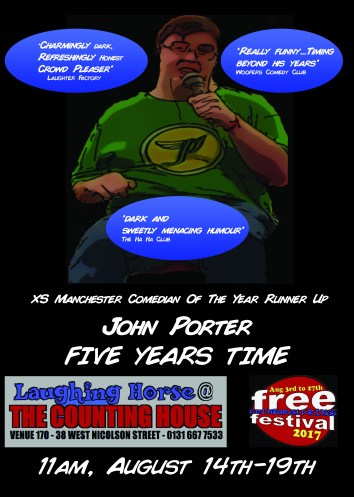
This year you are bringing us ‘Five Years Time.’ Can you tell us about it the show?John Porter Five Years Time Poster
Five Years Time is a show about how ridiculous the interview question ‘where do you see yourself in 5 years?’ is.  I don’t think anyone knows the answer, although I did have a sarcastic one (one of my favourite jokes in the show).,  I had to answer it at the time to try and get the jobs I wanted, but the whole show is about having no idea how wrong I would be at the time.  In hindsight, looking back on June, July and August 2012, I had little idea where I would be in 5 months, let alone years.  The show is about comparing expectations to reality – comparing me then to me now, the person I was and who I am now, and whether I am where I expected to be.  Spoiler alert: the answer is no.  The reasons why are in the show! 
One of the things I always say about my comedic style is that I made it anecdotal purely so no one else could be me, and in this question’s case, that answer applies.  It’s my story.  It’s fun in parts, sad in others, and surprising in many.   But one thing I am sure of is that it’s totally unique.  Even at a Fringe festival, I am 100% certain there will be no one who has my story in quite the same way.  To battle a disability, while growing up, working for the first time, doing stand up comedy across the UK, then falling in love (I will spoil that that bit didn’t end well – but the story is quite funny – at least nowadays), and somehow still going on and changing your entire life in five years?  That’s a unique story, and only my show has it.
 
What lessons have you learned from last year?

Hmm. I think every Fringe year has some learning to it.  But last year, I think I learnt:

– Don’t go paid when no one’s heard of you.
– Know what you want your show to be.
– Know how to sell it properly.

Essentially, mistakes all first-timers make.

What will John Porter be doing after the Fringe?
About two weeks after, I’m off to San Francisco for a holiday and to see my beloved 49ers – beyond that, who knows? I have an idea for a 3rd show, but time will tell if I think it’s worth progressing. One thing I am certain of is that I will still be doing comedy.  It’s a lifeblood to me and unquestionably the greatest thing I ever did for myself.  That’ll never go away.
————————————————–
John Porter will be performing @ The Counting House
August 14th-19th (11.00)