Hello Kwame, so where ya from & where ya at, geographically speaking?
Hello! I was born and raised in South East London, and now living and working up in Birmingham. My family originates from Ghana in West Africa.
When did you first realise you were, well, funny?
For as long as I can remember, I’ve enjoyed laughing and making people laugh. However, my first time performing stand-up comedy came as the result of a dare from a friend while I was in Sixth Form. At the time, I was just getting into stand-up (listening to a mix of Jack Dee, Chris Rock and Eddie Murphy). The idea of performing it myself had hadn’t crossed my mind, but the school talent show was coming up, so I thought I’d give it a go. A half-decent set performed in front of an overly-generous audience, and I was hooked!
Upon which life experiences do you draw your own comedy?
There aren’t many things that I’d say are off limits. I talk about my childhood, my family, friends and relationships, as well as things happening around me and in the news. I like to focus bits of material around people in my life who I find funny too. My Mum is definitely one of them, and she’s (unwittingly) found herself a solid place in my show.
What does Kwame Asante like to do when he’s not being funny?
When off stage and not at work, I enjoy playing sports (mainly rugby and football) and catching up with friends over a drink or two. I’m also a comedy addict, so will almost have some kind of stand-up or sitcom on in the background whilst pottering around my flat. Netflix is great for that!
You’ve been washed up on a desert island with a solar-powered DVD player & three films. Which would they be?
Rush Hour 2, Scary Movie 3 and The 40 Year Old Virgin. I hold no pretenses when it comes to watching films. I like easy viewing that I can sit down and switch off to.
Kwame won the 2012 Chortle Student Award before going back to his studies
Why stand-up comedy?
I like the freedom of it. An audience and a set amount of time, with the sole objective of being funny. I love toying around with how I spend that time, and interact with the audience. And the feeling of new material hitting home is unbeatable. Males it worth risking the trauma of dying on stage!
You are also a Junior Doctor. Do you include any observations from your ‘dayjob’ into your material?
I spent a long time avoiding talking about medical school and life as a doctor, but they now form such a big part of my life that it’s impossible not to draw humor from them. The trick is to strike a balance between keeping stories broad but accessible. Going into specifics can be a medicolegal bombshell. I currently enjoy talking about the challenges of establishing yourself as a new doctor, and staying professional in the face of weird and wacky personalities.
You are bringing your show, Open Arms, to the Fringe this August, can you tell us about it?
In Open Arms, I look back on the last three years, which has seen me graduate medical school, leave my family and home in South East London, and move up to Birmingham to settle into my new life as a junior doctor. It’s packed with funny stories, unexpected twists and hard-learned life lessons.
Can you sum up your show in a single sentence?
An uplifting, light-hearted, reflective comedy, with something for everyone!
How do you find performing at the mega-mash-up that is the Edinburgh Fringe?
Nothing beats the buzz of the Fringe. All of the comics spend all of the year writing, gigging, preparing and sharpening to be at their absolute best for the festival. And being surrounded by the energy and enthusiasm of other comics inspires me to be at my best as well. I hope to develop massively as a performer, and take the many lessons learned ahead of me into the comedy year ahead.
What does the rest of 2017 hold in store for Kwame Asante?
The Fringe is probably the highlight of my year to be honest! Straight after the festival I’ll be hitting the books, in preparation for the final part of the membership exams for the Royal College of Physicians, taking place in November/December. 2018 should be more interesting, where I hope to take my comedy to Australia, New Zealand and pretty much anywhere else that’ll have me!
Hello Richard, so where ya from & where ya at, geographically speaking?
Hello Mumble, I’m originally from Gloucestershire, lived in London for twenty years and now live in Los Angeles.
Who are your comedy idols?
So many… I just love people who can make me laugh. How about a list of the ones I’ve met, or have worked with? Robin Williams, Peter Cook, Billy Connolly, all the Pythons, Ken Campbell, Carl Reiner and Mel Brooks, Jack Black, My Oxbridge / Not the Nine O’Clock News contemporaries (Mel Smith was a very close friend from my university days, a lovely, generous soul and much missed) – Griff Rhys Jones, Pamela Stephenson, Rowan Atkinson, Douglas Adams. Ones I haven’t met: Damon Runyon, Dorothy Parker, P.G. Wodehouse, S.J. Perelman, Terry Pratchett – writers with the gift of lightness who have all given me the gift of laughter.
What does Richard Sparks like to do when he’s not being funny?
Play the five-string banjo (bluegrass style); play Elder Scrolls Online; eat (I love to cook) and drink beer – if possible at my bar in Las Vegas, Sporting Life Bar. It’s a neighborhood bar, for the locals, not a tourist joint: great world beers, great food, great people. Every now and then, maybe four or five times a year, my wife and I jump into the car and drive to Vegas, listening to a book on tape (PLEASE read Ernest Cline’s Ready Player One before the Spielberg movie comes out at Christmas. Or listen to it read by the madly enthusiastic Wil Wheaton. It’s a brilliant, exciting adventure story. I played against Wil in a poker tournament once. He’s a lovely guy, but an even worse poker player than I am).
You’ve been washed up on a desert island with a solar-powered DVD player & three films. Which would they be?
All British, all brilliant: Still Crazy, written by the great comedy team of Ian La Frenais and Dick Clement, with a cast of comedy rock stars (very appropriate); The Life of Brian, which is a genuine masterpiece; and Withnail and I. Bruce Robinson (its writer-director) is God. He is also in Still Crazy.
What are the secrets of a good sketch?
Surprise. You have to stay at least a step and a half ahead of your audience. Laughter is, after all, a reaction of surprise. If I tell you a great joke, you might well laugh. If I then tell it to you again, you probably won’t. If the audience knows where it’s going, and what is going to happen, you’ve lost them. One tip: cut out the questions. Lines like “Why is that?” or “What do you mean?” are dead wood. A waste of a chance to cut across the grain. A poor sketch is one in which one person asks questions and the other one gives answers. That is very laboured, very ploddy. I genuinely believe that audiences are intelligent. They can take everything you can throw at them. If some of them don’t get a joke, so what? Don’t spoon-feed them pablum. Don’t talk down to them. Give them something to stretch for.
Rowan Atkinson performing the sketch Richrad wrote for him, The Schoolmaster. This was his breakthrough moment, in The Secret Policeman’s Ball. He went onstage an unknown, and came off a star.
You are heavily into the creation of Opera – do you see any similarities in the Opera performance & the Comedic, or are they poles apart?
Both demand the use of your wits. Any libretto, any lyric, any script, needs as few words as possible. It’s very easy to overwrite when you start out. You learn that rewriting and cutting and polishing is where you get the gold. To have had the chance to write major opera productions is an incredible privilege. I’m not from a musical family – I saw my first opera aged about 25, and thought, wow, this isn’t cobwebby old fart fustian, this is… big! The last one I wrote (and directed) for the Los Angeles Opera, Dulce Rosa, took thirteen years from concept to performance. That was a romantic tragedy based on an Isabel Allende short story. She is a writer I really like and admire. It is the story of a revenge, an obsession; a two-pronged love story which takes us to some deep, dark places. I remember trudging upstairs to bed in the mornings, brain empty, wondering what the hell they were saying to each other… How do you sum up obsession? She is haunting him, calling him to her, to atone for the wrong he did… What is going through her head? Through his? And then, drifting off into that alpha state where the ideas can come, I got the lines: Day In, Day Out / Night After Night…… And I was off to the races. So basically: I love a puzzle. A challenge. I would much rather aim high and miss than aim low and hit. I’ve actually done a lot of aiming high and missing! My first poker book, Diary of a Mad Poker Player, was about me setting out to become the next World Champion of Poker. I didn’t. But in the failure, there was a story. And a sequel. And a fascinating world to explore. And if it hadn’t been for that journey, I wouldn’t now own my lovely bar in Las Vegas.
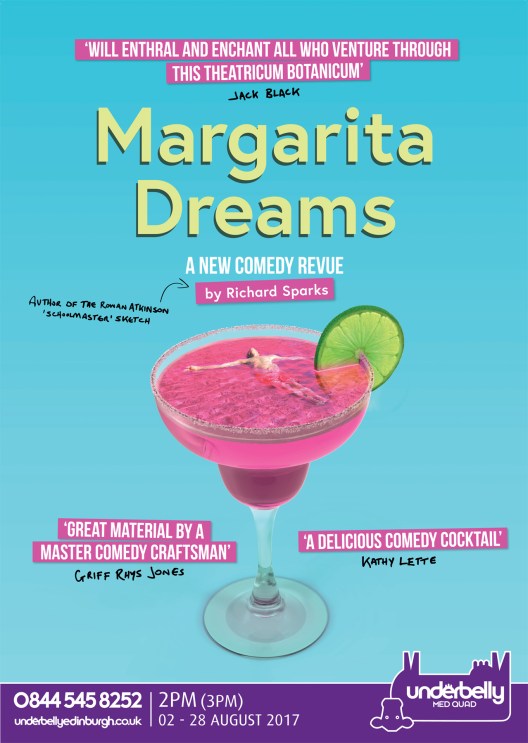
You are bringing your show, Margarita Dreams, to the Fringe this August, can you tell us about it?
We go inside the head of young Dave, on his holiday on the beach in Mexico, who has one margarita too many. Or nine. In the sun. It’s a freewheeling kaleidoscope of sketches that weave in and out of each other, all somehow weirdly making sense. I hadn’t written sketch comedy in decades, and had completely forgotten what a joy it is. It all came pouring out in just a few weeks. I can’t thank these kids (Bella, Jack, Jason and Sophie) enough for being the inspiration that got me to come up with all this strange and unexpected stuff. I’ve been lucky enough and, okay, stubborn enough, to just do exactly what I want in life: which is to write. I was never going to do anything else, and never have done. In my early days – and I’m grateful and happy as hell to have “been there and done that” – I had to write quite a lot of “crap for money”. Fixing misfiring sitcom scripts. Doing your best with other people’s ideas, trying so hard to make them work. One week, in a motel in New Zealand with orange carpet squares for wallpaper (yes, really!) I wrote three complete half-hour scripts from thin air. We were so behind schedule I didn’t see daylight for a month. I wouldn’t trade that experience for the world. That gig bought me my first house (well, one third of it, the rest was mortgage). And now, when something like Margarita Dreams comes along: it’s like jumping on a roller-coaster. So exciting! If you’d told me back in February I’d be coming to Edinburgh with an all-new sketch comedy show: I’d have slapped you until I woke up. So, tip to young writers/artists/actors etc: keep your eyes and your mind open. You never know what’s coming your way.
Can you sum up your show in a single sentence?
Welcome to the world of Margarita: where peculiar is the new normal – and a good, if unexpected, time is had by all.
What emotive responses would you like from your audience & what do you expect?
Belly laughs. All we want to do is give you a good time. The actors are the age I was when I did my first fringe show. My life as a writer really began here in Edinburgh. I hope good things now happen for them.
It’s been some time since you were performing in Edinburgh – four decades in fact – can you tell us what the Fringe was like in those days?
My memories of the fringe in the 1970s are of a freewheeling, enthusiastic, theatre-counter-culture month-long happening. The vibe was part rock concert, part chaos, part This Is The Real Damn Thing (as opposed to the commercial crap of the West End). And the things I saw! Ian Holm and Patti Love in Caravaggio Buddy at the Traverse, followed by Lindsay Kemp’s Les Fleurs du Mal dance/movement/weirdness extravaganza. The Polish director Tadeusz Kantor’s The Dead Class at the Richard Demarco Gallery (where we also performed). The Great Marcel’s one-person puppet show in a motorcycle sidecar (you, the audience, were the one person). Billy Connolly’s The Great Northern Wellie Boot Show – damn that was amazing! I bought the T-shirt.
What does the rest of 2017 hold in store for Richard Sparks?
Finish the new opera for the Los Angeles Opera – The Kugelmass Episode, based on the short story by Woody Allen. I’ve completed the first draft, and heard nothing back from my composer, Lee Holdridge, in two weeks! This I regard as a good sign. Lee and I have been writing partners for 25 years, so I know he’ll let me know right away if I haven’t given him stuff he wants to work on. Placido Domingo is going to sing the lead role – this project was his idea. We present a full sing-through workshop to him and the LAO bigwigs in October. In other news – just like coming back to Edinburgh after 41 years – 25 years since I last wrote TV, I’ve recently completed the scripts for the first season of a new series in L.A., to be produced by Jonathan Sanger (producer of The Elephant Man, Vanilla Sky etc). Just as with Margarita Dreams, it was a case of – hey, why not? Watch this space.
And Another Thing
I get two questions all the time from young “Should I’s”:
Question 1: Should I go to L.A. / London and try to be a writer / actor / director / producer?
Absolutely! You don’t want to be looking back in your 80s thinking, I could have been a contender. Go, try, succeed, fail, damn the torpedoes! Give it your best shot. Over and over and over again. Until you have nothing left to give. Live it, love it, settle for nothing else. Follow up question: “Oh, right well, so how do I go about – ” I have no idea. That’s up to you. Every case is different. They don’t need you. You have to make them. Easy? No, but who the hell cares? If you have to do this, then do it.
Question 2: Should I go to Las Vegas and be a professional poker player?
Absolutely not. It’s a wretched way to make a living: pillaging other people.
Hi Geneva, so where ya from & where ya at, geographically speaking?
I’m from the San Francisco Bay Area. I grew up in the East Bay in Oakland and I still live there.
Performance is clearly in your blood – when did you gain the first inkling of this?
I started doing theater classes and summer camps when I was 12-years-old. When I was 15 I joined the high school drama club and that became everything to me. I ended up moving to the UK to study contemporary Theatre at York St. John University and that’s when it became a lot more than just something I do for fun.
When did you decide to do stand-up?
I decided to do stand up in the summer of 2015. It was the summer before third-year of university when our course assigned an independent practice as research project in any field of performance. I decided to research the role of Jewish humour in stand-up comedy. I started reading about Jewish humourists and watching a lot of Joan Rivers and Sarah Silverman. After doing a lot of research to begin, in October 2015 I started going up on stage with my own stuff.
What is the comedy scene like in San Francisco?
It’s very vibrant. There are open mics every night of the week. We are spoiled for stage time. However, there are a lot of comics going after that stage time which means the nights can be very long and tedious waiting for your turn. San Francisco comics are generally talented and very hard-working. It’s inspiring to be around so many driven people and also a lot of diversity.
What does Geneva Rust Orta like to do when she’s not being funny?
I like to plan the next time I will be funny. I like the solitary and silent side of life. I’m exceptionally introverted so a few hours in a quiet room reading or drawing is my version of doing something fun. I also sometimes cry, (which can be funny at first) but isn’t that funny after a while.
What makes you laugh personally?
I think sex, death, and stupidity are all hilarious. Especially sex. It’s pretty easy to make me laugh. I like underdogs making fun of authority. I laugh the most at sarcastic women. Sarcastic women never cease to comfort me.
Upon which life-experiences do you draw your own comedy?
My moms. I have lesbian parents who divorced when I was young and married two new women, so I have four mothers to talk about. I also talk about my grandmother. The values and feelings I talk about are all things that I’ve learned from the women who raised me. I like to talk about the eccentric lessons they’ve taught me.
This is your second time at the Fringe. Can you explain in one sentence what it is like to perform at the mega-mash-up that is the Edinburgh Fringe?
It is humbling but also uplifting to be around so many intelligent people asking me about what I bring to the table.
Can you tell us about this year’s show?
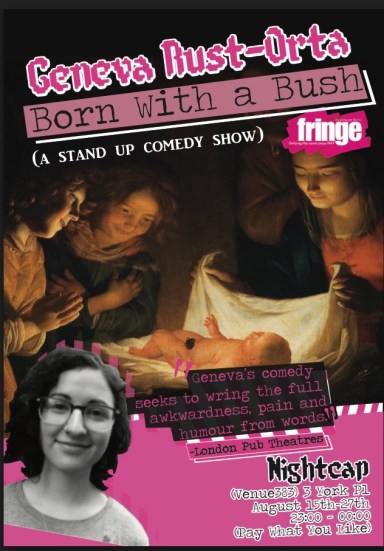
This year’s show is further developed from last year’s show to be sure. I’ve tried to move on from dark bitter humour to dark playful humour. There are still holocaust references and a lot of sexual frustration in my material but I also think I’ve loosened up. My show is about feminism, sex, and Jews and how I have known them in my life.
What is it about performing live you love the most?
I like being around other people with good intentions. Comedy communities remind me of what religion felt like when I was younger. I’ve stopped attending religious services for the most part but I’m constantly hungry for the feeling of unity and humanity that I had growing up as a Jewish kid with a Temple to go to. Now I get that feeling almost exclusively from live comedy.
What does the rest of 2017 hold in store for Geneva Rust Orta ?
I’m in a bit of an in-between place. I hope to attend Central School of Speech and Drama in the Fall of 2018, but I need to save a million dollars to afford it. Hopefully I find a rich family who will pay me to watch their hilarious and well-behaved child for a couple hours per day. I’d also like to rally behind a social cause that really inspires me. I’ve been taking a teaching course geared towards equitable education for underrepresented student demographics. But to be honest I will probably just continue to waste money on beer and pizza and wonder why I’m single.
Hi Gary, so where ya from & where ya at, geographically speaking?
Originally, I’m from a place called Chipping Sodbury, just outside Bristol. JK Rowling was also born there so it’s pumping out some creative juggernauts. It’s probably because of the big Tesco they’ve just built… it’s really inspiring. I’m currently in London, sat at my laptop, Ecosia-ing
When did you first realise you were, well, funny?
When I was in primary school, my teacher, Mrs. Eyres, was pregnant. She held a competition whereby the class would suggestion baby names. I suggested Pubic, so that it’s name would be Pubic Eyres. Yup. Nailed it.
Who are your comedy idols?
Genuinely, I mostly take inspiration from the guys that I came up on the circuit with. It might just be because I’ve seen these people grow (creatively… and literally, some of them were quite young) or because I get to watch them live all the time, but all the most talented comedians in the world started stand-up between 2009 and 2011. That’s just a fact. You can’t even argue with it so don’t try.
Upon which life-experiences do you draw your own comedy?
I enjoy making the mundane ridiculous. I also like being self-deprecating. Comedy should always be about punching up or punching yourself. I choose to punch myself.
What does Gary Tro like to do when he’s not being funny?
I’m currently addicted to a game called Overwatch. It’s an online *pew pew* thing that you play with other people/idiots who doN’t kNOw HOw To PLaY PROpERLy SO END UP LOSING US THE MATCH!!!! 0_o It’s really fun.
Your exceptionally titled show did rather well at last years Fringe. What motivated you to do it all again?
Complete lack of demand. The show was a massive commercial disaster last year – hardly anyone saw it. I was in a venue in butt-fudge nowhere at a ridiculously competitive time. However, the feedback from everyone that did come was overwhelmingly complimentary. And I love doing it. I think it’s a fantastic show, which I’m really proud of. It’s some of the most hilariously honest bullshit you’ll ever see. (When you’ve printed this, can I use that as a quote??) “…some of the most hilariously honest bullshit you’ll ever see” – Mumble
What does the show have to offer for the discerning comedic punter?
As well as being the best named show on at the fringe, it’s also an hour of intensely, hilarious fury…
Can you explain in one sentence what it is like to perform at the mega-mash-up that is the Edinburgh Fringe?
It’s almost exactly the same as puberty but with more Berocca.
What is is about performing live you love the most?
The immediacy. I genuinely believe that the best art and performance happens in the moment. The biggest laugh that every comedian has ever had has come from something that they didn’t plan to do.
What does the rest of 2017 hold in store for Gary Tro?
Edinburgh and then recover from Edinburgh. I’m working on a few projects and will hopefully be taking a show on tour at the end of the year.
Hi Nathan, so where ya from & where ya at, geographically speaking?
I was born and raised in Melbourne, Australia. I moved to London ten years ago and live in Hackney with my wife and two dogs. She’s Scottish and they’re Chinese. We go to Scotland a lot but not China.
Performance is clearly in your blood – when did you gain the first inkling of this?
My first memory of performing was in the early 80s when I would amuse myself and no-one else by recording comedy sketches onto cassette tapes. I would parody TV commercials and personalities, do silly characters. Sometimes I’d layer extra voices and sound effects by using an extra cassette deck, the kind of high-tech innovation that got us to the moon.
After a successful career on Australian TV, why branch into Comedy?
Your intriguing use of the word “successful” suggests I actually had a successful career on Australian TV. I had some excellent guest roles and got to play Pinhead on Neighbours for two years, but I don’t think my TV career ever really took off there. I was never made any offers, I still had to audition for hundreds of jobs I never got. But I was always doing comedy. I wrote, performed and directed university revue shows, and started out at Melbourne International Comedy Festival doing sketch comedy, all while maintaining my dynamic daily routine of waiting for my agent to call.
Who are your comedy idols?
The only act I’ve ever been properly fanatical about is the Doug Anthony Allstars. I grew up watching them on TV, went to their live shows, wore the T-shirt, bought all the merch, got interviewed by press at their Farewell Tour in 1996 and consequently reprimanded by my headmaster for bringing shame to the school for associating with such a subversive act. I always loved Flacco too, a really bizarre clown – his creator Paul Livingston is a linguistic gymnast. I can’t wait to see them all together in Edinburgh this year. I hope to bore at least one of them with my tale of how they inspired me to be an unemployed career comedian.
What does Nathan Lang like to do when he’s not being funny?
Oh that’s a lot of the time, even on stage. I have two companies – Jon & Nath (sketch) and Farce Forward (clown theatre) – and I run experimental comedy night Lost Cabaret, so there’s a lot of admin, which is not humorous. Before answering this question I got up and swept the floor, so I’m doing really well.
You’re still making TV & Films, where should we expect to be seeing you?
I just filmed a small part in The Favourite, a feature film directed by Yorgos Lanthimos. I remember watching The Lobster and thinking how much I’d love to work with such a peculiar, visionary director… Suddenly I’d auditioned for him and was on his set. The Favourite stars Olivia Colman, Rachel Weisz and Emma Stone, they are all brilliant, the film is going to be amazing, and you can see me in it next year if you watch very closely.
You are bringing The Stuntman to this year’s fringe… can you tell us about it?
The Stuntman is my first solo show, it’s so much fun and I just love doing it. Essentially it’s a clown piece – absurd, surreal, silly and interactive. There’s mime, but it’s not a silent show. It’s the story of a completely idiotic daredevil, told through physical comedy, games, actual stunts, and a few touching moments too. I decided to make it largely non-verbal so it’s accessible to everyone regardless of language.
What makes you laugh personally?
My dogs crack me up. They are good clowns. We adopted two rescues – Albert Fudge and Cherub Chow. They’ve learned to be cute and silly to get attention and treats, and they do some ridiculous things. If you’ve never seen two Shih Tzus playfight, put it on your list. My wife and I call it Dog TV because we don’t have a TV. (As far as TV Licensing is concerned, we never watch anything online either.)
Will you be performing the Stuntman after the Fringe?
Yes I hope so because my Edinburgh Fringe run is only short (eleven performances – I’m splitting the Fringe season with my sketch comedy show Jon & Nath Like To Party). It’s a high-energy show, very physically demanding, so I want to keep doing it before I become a middle-aged slob. I am open to booking offers from anyone but cruise ships.
Hi lads, so where ya both from & where ya at, geographically speaking? Jon : I was born in London and Nath was born in Melbourne. I moved to Melbourne and lived there for a while where I met Nath. Then we both moved to London and have been living here a while. There’s a nice symmetry to our geography.
Can you describe your chemistry with Jon? Nath : Jon and I are brothers. We’re twins in the womb and he’s the one who gobbles up all the food, leaving me malnourished and gaunt. We disagree about pretty much everything except our own comedy work. We actually fell out for three years and it’s really helped us come together with even more antagonism than ever before. I asked Jon to marry me once, bought him flowers, got down on one knee and everything. If he’d said yes, this year I’d be giving him a silver sugar bowl for our 16th anniversary. True story.
When did you realise you were, well, funny? Jon : I think everyone has the ability to make other people laugh but getting paid for comedy the first time was a landmark night. There is no better sound than the sound of laughter you’ve created. Equally, there is nothing more crushing than hearing some guy yell out “You’re not funny, you ugly wanker!” from the depths of a darkened room. So in conclusion probably around mid-2000.
What are the inspirations behind your own comedic output?
Nath : I grew up in Australia watching excellent British TV comedy like Kenny Everett, The Young Ones, Blackadder and Fry & Laurie. And Aussie stuff like Fast Forward, The Comedy Company, The Big Gig and The Doug Anthony Allstars. So I like a bit of anarchic danger underpinned by well-written, well-rehearsed material, and recurring characters. I grew up on sketch comedy and have always loved doing it. Lately I’ve been training in and watching a lot of clown (I’m also doing a solo clown show this Edinburgh Fringe called ‘The Stuntman’). I’m inspired by everyone I see doing comedy, there are limitless perspectives on what is funny and how to generate laughter.
How did you guys meet? Jon : We saw each other’s shows in the Melbourne International Comedy Festival, then went out drinking on the beach. Nath and I were smoking, and he said “Don’t drop the butt in the sand, I’ll put them in my pocket.” I was just about to say the same thing to him, so a life-long friendship was born! We were socially aware before it was cool. Oddly we have almost nothing else in common whatsoever.
What’s the difference between an Australian audience & a British? Nath : Audiences in Australia like to have comedy thrown at them, whereas in the UK people examine everything you do, and appreciate nuances. It’s a difference of subtlety.
You’re bringing ‘Jon & Nath Like to Party’ to the Fringe. Can you tell us about it. Jon : ‘Jon & Nath Like To Party’ is a pretty sweet sketch show we have been working on since Camden Fringe last year. It has everything from incredible robotics* to stella guest appearances**. We’ve worked really hard to get the show to a relentless pace, mixing the absurd and satirical without overdoing either. *Jon in a shitty tin-foil suit ** Nath’s below-average impressions
What are the ingredients to a good sketch? Jon : I think stupidity, bad accents, wigs and fake moustaches while Nath insists it is good craft, clever writing and lots of rehearsals. We meet in the middle and that’s what makes ‘Jon & Nath Like To Party’ so good.
You performed ‘Jon & Nath Like to Party’ at the Brighton Fringe. Have you been making any tweaks since then? Nath : Yes I’ve tried to write Jon out of the show but he keeps turning up at gigs. We’ve been working on ‘Jon & Nath Like To Party’ for a year, so Brighton Fringe was a version we are very happy with. Our aim is to create a sketch show that also communicates our relationship through an underlying narrative of thwarting and one-upmanship. By the end we’ve messed each other up pretty good. At our latest preview we started bitching about each other directly to the audience, but it’s really quite sentimental too.
What will Jon & Nath be doing after Edinburgh? Nath : I heard an anecdote about what Miles Davis and John Coltrane would do after jazz gigs – Davis would go out partying, and Coltrane would go home and practise the bits he wasn’t happy with. Jon and I will probably just do the Davis. Then we’ll keep booking gigs, writing, filming, working on a new show, and hopefully touring ‘Jon & Nath Like To Party’. The lols aren’t going to make themselves (until we’re rich enough to pay people to make the lols for us and package them for internet orders).
Hello Danny Lobell, so where ya from & where ya at, geographically speaking?
I’m from the cosmos and I’m feeling more at one with them than ever. That could also be interpreted as “New York” and “LA.”
When did you first realise you were, well, funny?
I made the doctor laugh as I was being delivered. Before he could even cut the umbilical cord I told him a really funny story about being in the womb. Had him rolling. He laughed so hard he almost forgot to cut me loose. Then I did 20 minutes of stand up in an incubator. It’s some of my best stuff. I wish I’d written it down.
Why stand-up comedy?
It’s a great format for painting pictures in people’s heads. I like making people laugh and bringing them joy. I also like comedians. They are some of my favourite kinds of people. They are usually misfits, messed up in some way, or even complete degenerates but they all have big hearts, lots of creativity, and don’t let a conversation get too boring for too long.
Upon which life-experiences do you draw your own comedy?
The ones that I find funny. You have so many experiences every single day and every single moment of your day is occupied with something. But at the end of the week how much do you actually remember? And of what you remember, how much of it makes you laugh? I try to isolate the funny parts of the week and when they compile, I tend to select the funniest ones of them. I then merge them together into a show.
What does Danny Lobell like to do when he’s not being funny?
I like to paint, write comic books, play with my dogs, watch TV with my wife, do repairs around the house, and cook.
You did rather well at the Glasgow International Comedy Festival, can you tell us about the experience?
Rather well? I was phenomenal! And that’s me being humble! I’ve been privileged enough to have done the Glasgow International Comedy Festival three times. I got some great write-ups in The Scotsman and The Daily Record. I got to be on BBC Scotland radio. I made some wonderful friends with whom I’m still very much in touch like the hilarious Raymond Mearns. In my opinion, he’s the funniest man living in Scotland right now. All the people who run the festival are terrific. Sarah Watson has a great eye for talent and makes everyone feel very at home when they do the festival. I even recorded an album at the festival the last time I was there in 2011 at The Stand in Glasgow. It’s probably my favourite comedy club in the world.
What is it about performing live you love the most?
It’s the only way I ever perform. I like doing everything live. I like eating live, sleeping live. In fact, being alive has really enhanced most of my life experiences.
You are bringing your show, Broke as a Joke, to the Fringe this August, can you tell us about it?
It’s a collection of stories, anecdotes, and jokes that revolve around my adventures that came out of being broke. It includes everything from odd jobs like selling light bulbs door to door and working for comedy legend Jackie Mason selling audio cassette tapes at his Broadway show. I also talk about failed business ideas like breeding hairless cats and selling eggs to hipsters. It’s got action and adventure in it, like when I pulled off a drop and run of a rooster with a former drug lord and returned a year-old piece of salmon with my dad to the store. The show is funny, exciting, heartfelt, and comes with a little advice I’ve learned along the way.
As a cross-cultural child, will we be seeing touches of each humour in your set?
Yes. I was raised with humour on both sides. I think New Yorkers and Glaswegians, both being very blue collar, depend heavily on comedy to get through life. I developed sharp comedic sensibilities having been raised by parents from these two great cities.
This will be your debut at the Fringe… what have you heard about it from other performers?
I’ve heard that it’s one of the most fun and challenging months of performing and I welcome both the fun and the challenge.
What does the rest of 2017 hold in store for Danny Lobell?
Wonderful wonderful things. Some of them are highly top secret, so secret in fact that I don’t even know about them. But I’m telling you they’re great. I heard a rumor that I’m going to win a llama farm in Peru while appearing on a local game show there. One of the llamas, unbeknownst to them before they signed it over to me, has very rare markings on its back. These markings make it very collectible on the llama message boards on the dark web. I will be offered an incredible sum of bit coin for this llama. We will have to meet up in person with the llama for its assessment before the transfer goes through.
When I get there, I will recognise two Serbian men. One of them bald, with eyebrows under his eyes instead of on top. And the other one looks pretty normal but has way too much sodium in his diet. He doesn’t even realise it but he’s at risk for all sorts of severe health problems. As they start looking over the llama, I remember where I’ve seen that normal looking Serbian guy. He was on PETA’s most wanted list for verbally abusing a red panda in 1999! I will know right there and then that I am NOT selling this llama off to these two guys.
I try to excuse us politely from the situation but they can tell something is up. As it becomes increasingly uncomfortable, we try to make a dash back to my two-door Mazda Miata convertible that I rented at the airport. But the two Serbians chase after us. It’s at that point that the llama and I put our backs together and start fighting these two guys as a llama-human-ninja team. We beat the crap out of them, jump into the Miata and drive away.
Just when I think there is no way I’m ever gonna be able to cash in on this llama farm thing, I find out that TMZ got ahold of the security footage and that the llama and I have gone viral. All kinds of offers start pouring in from Hollywood for an action buddy cop movie. We become a franchise and retire after making only five movies that gross more money collectively than all the super hero movies of the past decade combined. We buy a small island and live out the rest of our lives sipping mojitos and oatmeal puree (that’s what llamas like to drink) while watching the sun go down over the ocean.
If that doesn’t happen, then probably some more gigs.
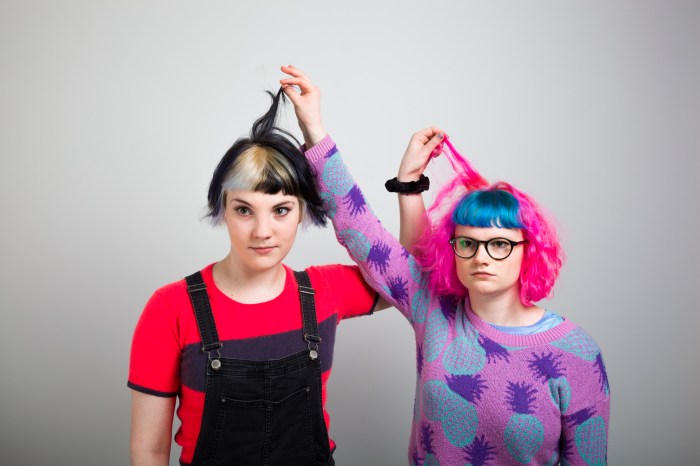
Where y’all from and where y’all at? Siân: I’m originally from the suburbs of Brussels, Belgium, so yes I am very exotic. Zoë: I grew up on the Isle of Arran in Scotland. We’ll leave it up to you who won in the ‘mildly unusual hometown’ category. We’re both now based in London.
Can you describe in one sentence the experience of performing at the Fringe? Siân: “Zoë I’m so sorry about eating the props.”
When did you first realise you were, well, funny? Zoë: I was about 16. I wrote a comedy play about a murder on the set of a kid’s TV show. I’d written sound effects into the script like I had the full BBC Radiophonic Workshop in the tech box, but actually it was just my mum. She obviously messed up one of the cues, so I broke character and said: “I knew I shouldn’t have asked my mum to do the tech”. The music still wasn’t playing so I kept improvising, which was much funnier than what I had written. That’s when I first thought: “People laughed when I said something that wasn’t pre-prepared”. My mum still comes to our shows and heckles us so we can make jokes about it. Actually maybe it’s my mum that’s funny. Maybe the act should be Siân and Zoë’s Mum?
Why comedy, what is it about being funny in front of other people that makes you tick? Siân: The first time I did stand-up was after auditioning for a Footlights gig I didn’t get into. There were two guys outside the audition room who told me they were organizing a fundraiser comedy gig, and did I do stand-up? I lied and said “Yeah, sure”. The ten minutes of “comedy” I did was resolutely average, and probably better just described as “words.” But I got the bug for it. I’d also done odd bits of sketch comedy about things like IKEA furniture having a nervous breakdown, sex guru post-it notes and various other haunted-office-equipment-related material. Which has kind of just kept going. The reason it makes me tick may well be that I ill-advisedly swallowed a desk clock during a sketch at some point and the battery poisoning made me forget all about it.
Upon which life-experiences do you draw your own comedy? Zoë: I also absolutely love horror films, which I hope comes across in our show this year. I once made Siân watch ‘The Exorcist’, and she still thinks the girl is climbing down the stairs backwards to get her. To be honest, Siân’s better at using actual life experience than me; her solo stuff manages to explore personal identity in a way that isn’t annoying. And that’s high praise from me as I am easily annoyed, especially by Siân.
So Siân, you are currently doing some serious acting in “Queers” at the King’s Head Theatre. Is this experience influencing your comedy act with Zoë in any way? Siân: It has, in the sense that I think all performance experience is valuable and teaches you something. The “seeryuss ahhcting” has pushed me out of my comfort zone, and I’ve had to convey all these emotions without the safety of making a joke about it. It’s pretty exposing and I’m not sure if I like it. But I love the show. And I do think – in a way that possibly borders on the obnoxious – that it’s important to be visible and honest as an LGBTQ person, within the limits of what’s possible for your own safety. This is the second time I’ve performed in “Queers”, and for a while I was the frontwoman of a feminist cock-rock drag band called “The Dykeness”. So yes, it has influenced our act, in that it has made me an expert on “keeping it subtle”.
How did S&Z come about? Zoë: Siân auditioned for a stand-up comedy night I hosted at university. I thought “Wow, she does what I do but better. I should 100% drag her down to my level”. We’d never written any sketch comedy together so obviously we wrote an hour in a week and ran it for five nights in a row. We’ve been working together ever since.
So Zoë, can you tell us about your dayjob as a researcher?
I work in TV as a researcher for comedy panel shows, finding props, pictures, clips and anything else that can lead on to gags. I’m delighted someone wants to pay me to be a comedy nerd, because before this I’d been doing it unpaid since I was 11. We also develop games and sketches, which means when I’m working I have to keep contacting Siân to ask: “Have I accidentally stolen this idea from our writing session last night? And if so, please can I carry on stealing it?”.
What are the ingredients to a good sketch? Siân: Every sketch is different and every sketch act is different. But I think a key thing across the board is to have one core idea for each sketch, and see it through. Having said that, the original ingredient in a sketch is your own voice. Sketch groups we really like can both write sketches that anyone could perform, but also have a style that is distinctly theirs. And that comes down to the personalities, interests and idiosyncrasies of the writers/performers. I felt like there were two or three sketches in our show last year that were really “ours”, which was cool. It can take ages to figure that out. But it’s the most fun.
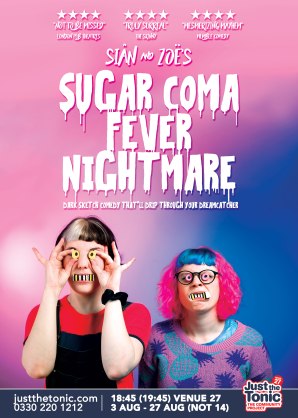
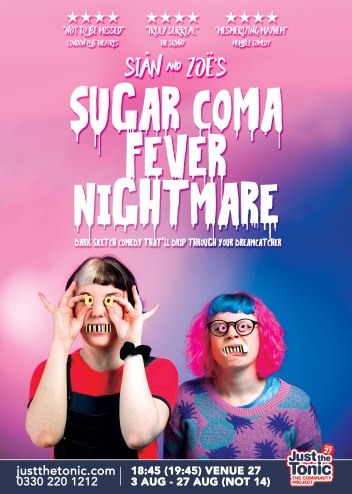
You are bringing Sugar Coma Fever Nightmare to this year’s Fringe, can you tell us about it? Zoë: Sugar Coma Fever Nightmare is a dark sketch show about bad dreams, and two people made of liquorice who want to eat flesh allsorts. Siân: It’s still very much an alternative comedy show, so there’s lots of visual business and the offbeat stuff that we like. But the dream setting has given us loads to play with in terms of characters and sketches that exist just outside of reality. Please note that although the show is dream-themed, we have put a lot of work into it so having a nap through the show will not produce the same effect. (HI DAD.)
This is not your first time at the Fringe, what have you learnt in the interim about your set? Siân: The Fringe has something for absolutely everyone. One year I was in a folk-punk opera version of “The Bacchae,” mostly about binge-drinking, aimed at ten year olds. It did alright. Also, there are pretty decent £1 sandwiches in Boots. Artistically, this is very important.
Was constructing this year’s show easier or more difficult than your first? Zoë: Much easier! Obviously we’re more experienced but the theme of dreams and nightmares works perfectly for sketch so I think we’ve had more fun with that – moving between sketches is much more natural if it’s happening in a dreamscape. It’s been exciting to pull characters from different parts of the show into each other’s sketches, as we move through the hour, to build the effect of a nightmare. I’ve also enjoyed pushing our bubblegum characters into horrible situations. Siân: Previous years have been nightmarish so we’re delighted we can finally put that extensive bank of experience to use.

 Hi Geneva, so where ya from & where ya at, geographically speaking?
 What makes you laugh personally?
 Can you tell us about this year’s show?
 Hi Nathan, so where ya from & where ya at, geographically speaking?





 Mumble Comedy